Train hard. Recover properly. Progress consistently.
When people think about getting results, they usually focus on the obvious things:
- Tough workouts
- Eating well
- Hitting step targets
- Staying motivated
But there’s one part of the process that often gets overlooked: recovery.
And ironically, it’s the thing that allows all the other hard work to actually pay off.
If you’re currently taking part in the Instinct28 Challenge, this is your reminder that recovery is not being lazy, falling behind, or “taking it easy”.
Recovery is part of the programme.
In fact, it’s where progress really happens.
What Actually Happens When You Train?
Every workout places stress on the body.
That’s not a bad thing; it’s how the body adapts and improves.
Whether you’re strength training, running, doing circuits or pushing through a challenging class, your body is:
- Breaking down muscle tissue
- Using up energy stores
- Taxing the nervous system
- Creating inflammation that needs repairing
Training is the stimulus.
Recovery is the adaptation.
Without proper recovery, your body never gets the chance to rebuild stronger.
That’s when people start experiencing:
- Constant soreness
- Low energy
- Poor performance
- Lack of motivation
- Plateaus
- Increased injury risk
More training isn’t always the answer.
Sometimes the smartest thing you can do is recover better.
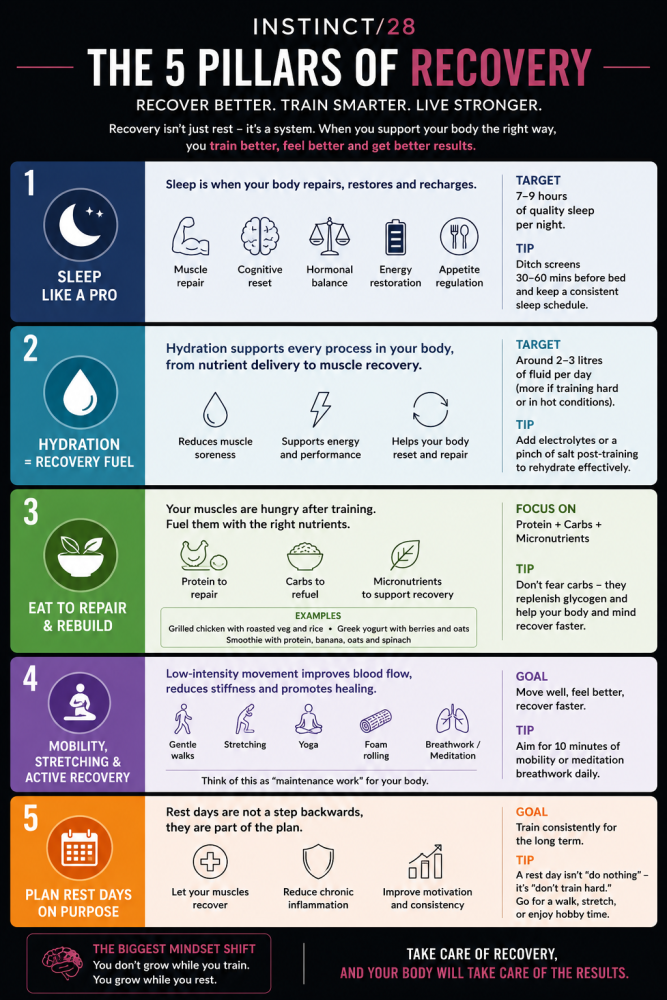
The 5 Pillars of Recovery:
(More information below the picture.)
1. Sleep: The Ultimate Performance Tool
If recovery had a secret weapon, it would be sleep.
This is when your body gets to work repairing muscle tissue, regulating hormones, restoring mental focus and resetting energy levels.
Poor sleep affects everything:
- Hunger levels
- Cravings
- Motivation
- Recovery speed
- Performance in training
Aim for 7–9 hours of quality sleep wherever possible.
A few simple habits can make a huge difference:
- Reduce screen time before bed
- Keep a consistent bedtime
- Avoid caffeine too late in the day
- Make your room cool and dark
Most people underestimate how much better they feel after a proper week of good sleep.
2. Hydration: The Recovery Multiplier
Feeling sluggish, sore or unusually tired after training?
Dehydration could be playing a bigger role than you think.
Your body relies on fluids to:
- Transport nutrients
- Support muscle repair
- Regulate temperature
- Maintain energy levels
Even mild dehydration can affect performance and recovery.
A good target for most people is around 2–3 litres of water per day, though this varies depending on training volume, body size and activity levels.
After intense sessions, adding electrolytes or even a small pinch of salt to water can help improve rehydration.
3. Nutrition: Give Your Body the Materials to Recover
You cannot recover properly without eating properly.
Training breaks the body down. Nutrition helps rebuild it.
A strong recovery meal should include:
- Protein for muscle repair
- Carbohydrates to restore energy
- Micronutrients to support overall recovery
Simple examples include:
- Chicken, rice and roasted vegetables
- Greek yoghurt with berries and oats
- A smoothie with protein, banana and oats
And despite what social media might tell you, carbohydrates are not the enemy.
They play a major role in refuelling muscles and helping your body recover efficiently.
4. Active Recovery Matters More Than You Think
Recovery doesn’t always mean doing absolutely nothing.
In many cases, gentle movement can actually help you feel better faster.
Things like:
- Walking
- Stretching
- Mobility work
- Yoga
- Meditation
…can improve circulation, reduce stiffness and help your body recover between sessions.
Think of it as maintenance work for your body.
You don’t wait for your car to break down before looking after it; your body works the same way.
5. Rest Days Are Productive
A lot of people feel guilty when they take a rest day.
But rest days are not a sign of weakness.
They’re a sign you’re training intelligently.
The people who make long-term progress aren’t usually the ones who go flat-out every single day.
They’re the ones who can train consistently for months and years without burning out.
Rest days help:
- Muscles repair
- Inflammation reduce
- Energy levels recover
- Motivation stays high
A rest day doesn’t have to mean sitting still all day.
A walk, some stretching, time outdoors or simply slowing down a little can all support recovery.